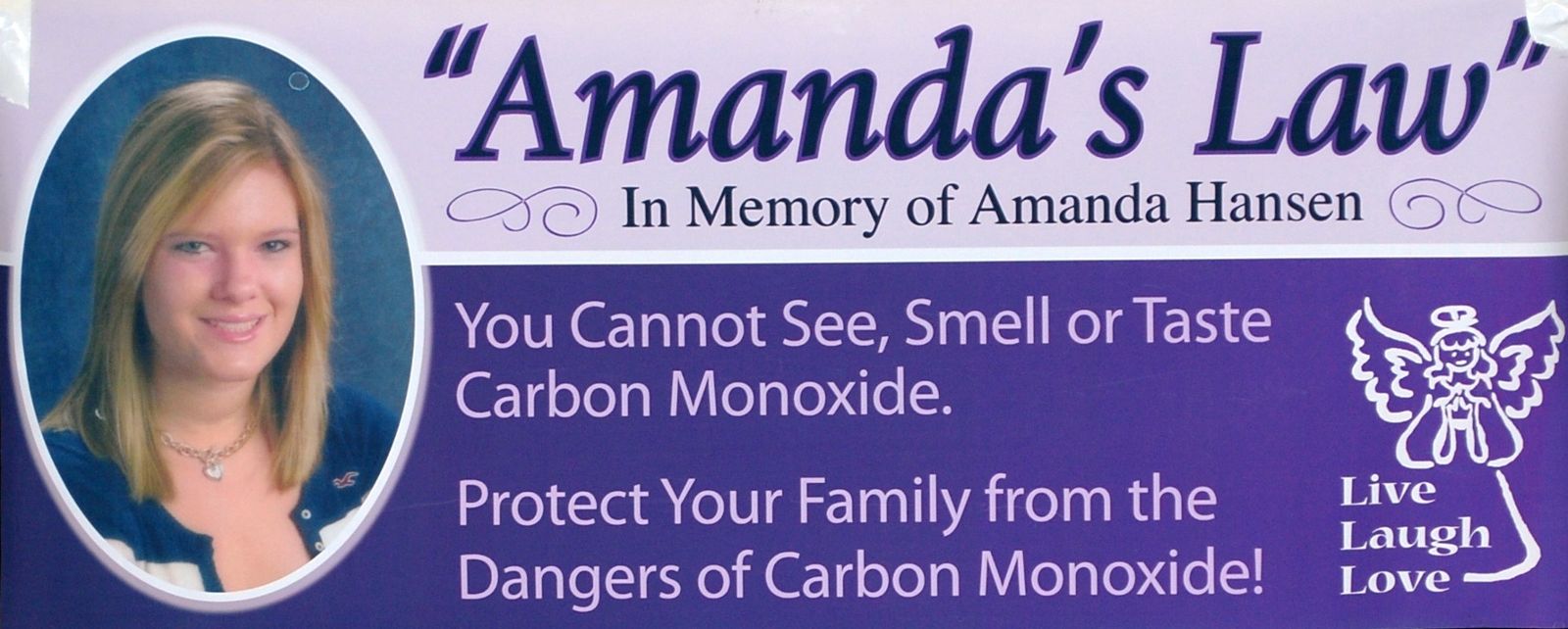
CO is called the silent killer because people cannot smell or see it and the effects of CO mimic flu-like symptoms and make people disoriented. Carbon Monoxide (CO) alarms should be installed in a central location outside each sleeping area and on every level of the home. For the best protections, interconnect all CO alarms throughout the home so that when one sounds, they all sound.
Every year, at least 420 people die in the U.S. from accidental CO poisoning. More than 100,000 people in the U.S. visit the emergency department each year due to accidental CO poisoning (source cdc.gov).
The New York State Office of Fire Prevention & Control (OFPC) works to ensure homeowners are aware of the hazards of carbon monoxide. The state law, known as Amanda’s Law, requires all residences, both new and existing, to have carbon monoxide alarms installed. The law went into effect in 2010 and is named for Amanda Hansen, 16, of West Seneca, who was found unconscious at a friend's house in January 2009. Officials later determined she had been exposed to lethal levels of carbon monoxide in the home's basement, where she and her friend were having a sleepover. She later died at South Buffalo Mercy Hospital.
More about Carbon Monoxide poisoning...
Carbon Monoxide is an invisible, odorless, colorless gas created when fuels (such as gasoline, wood, coal, natural gas, propane, oil, and methane) burn incompletely. In the home, heating and cooking equipment that burn fuel are potential sources of carbon monoxide. Vehicles or generators running in an attached garage can also produce dangerous levels of carbon monoxide.
Facts
- According to the National Safety Council, 200-300 unintentional-injury deaths a year are due to carbon monoxide poisioning.
- The dangers of CO exposure depend on a number of variables, including the victim's health and activity level. Infants, pregnant women, and people with physical conditions that limit their body's ability to use oxygen (i.e. emphysema, asthma, heart disease) can be more severely affected by lower concentrations of CO than healthy adults would be.
- A person can be poisoned by a small amount of CO over a longer period of time or by a large amount of CO over a shorter amount of time.
If your CO alarm sounds
- Immediately go outside or to a fresh air location and call for help. Remain at the fresh air location until emergency personnel say it is ok.
Symptoms of CO Poisoning
CO enters the body through breathing. CO poisoning can be confused with flu symptoms, food poisoning and other illnesses. Some symptoms include shortness of breath, nausea, dizziness, light headedness or headaches. High levels of CO can be fatal, causing death within minutes.
Safety tips in the home
- Install CO alarms (listed by an independent testing laboratory) inside your home to provide early warning of accumulating CO. CO alarms should be installed in a central location outside each separate sleeping area. If bedrooms are spaced apart, each area will need a CO alarm.
- CO alarms are not substitutes for smoke alarms. Know the difference between the sound of smoke alarms and CO alarms.
- Have fuel-burning heating equipment (fireplaces, furnaces, water heaters, wood and coal stoves, space or portable heaters) and chimneys inspected by a professional every year before cold weather sets in.
- When using a fireplace, open the flue for adequate ventilation.
- Never use your oven to heat your home.
- When buying an existing home, have a qualified technician evaluate the integrity of the heating and cooking systems, as well as the sealed spaces between the garage and house.
Safety tips outside the home
- If you need to warm a vehicle, remove it from the garage immediately after starting it. Do not run a vehicle, generator, or other fueled engine or motor indoors, even if garage doors are open. Make sure the exhaust pipe of a running vehicle is not covered with snow.
- During and after a snowstorm, make sure vents for the dryer, furnace, stove, and fireplace are clear of snow build-up.
- Only use barbecue grills – which can produce CO – outside. Never use them in the home, garage or near building openings.
|


